
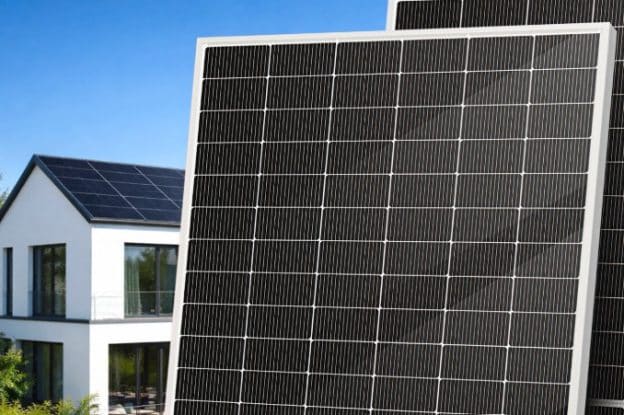
Roof space is finite. Energy bills are not. For commercial and industrial facilities, the goal is straightforward: pull the maximum kilowatt-hours from every available square foot. The 400 watt solar panel has become the industry workhorse for exactly this reason. It delivers more power per panel, cuts installation labor, and reduces balance-of-system hardware costs. Here is a practical breakdown of where and why 400W modules outperform their lower-wattage predecessors.
Technology Behind the 400W Threshold
Three core innovations pushed mainstream panels past 400 watts.
PERC (Passivated Emitter and Rear Contact) cell technology improves light capture by allowing photons that pass through the front cell to reflect off a rear passivation layer and get absorbed on a second pass. Half-cut cell architecture reduces resistive losses by splitting each cell into two halves, lowering current per path and improving shade tolerance. Multi-busbar designs shorten the distance electrons travel to collection points, further cutting resistive loss and improving long-term reliability.
Together, these features yield module efficiencies in the 20 to 22 percent range, up from roughly 16 to 17 percent for standard polycrystalline panels a decade ago.
A decade ago, a 400W panel was a niche product. Today it is the entry point, with many tier-one manufacturers shipping 420W to 440W modules as their standard commercial offering.
400W vs. 300W: Side-by-Side Comparison
The table below shows the practical impact of choosing 400W modules over 300W panels for a 100 kW commercial rooftop project.
| Metric | 300W Panels | 400W Panels | Difference |
| Panels needed for 100 kW | 334 | 250 | 84 fewer panels |
| Roof area required | ~620 m² | ~480 m² | 23% less space |
| Racking & mounting hardware | Higher cost | Lower cost | ~15% savings |
| Installation labor | ~160 hrs | ~120 hrs | 25% faster |
| Installed cost per watt | ~$2.60/W | ~$2.30/W | ~$0.30/W saved |
Those 84 fewer panels matter more than the numbers suggest. Fewer panels means fewer roof penetrations, fewer module-level connections to test in the field, and a faster inspection process. On a project where a crew bills by the day, labor savings alone can offset the per-watt premium of newer modules.
Ready to source panels for your next project? Browse 400W inventory with real-time pricing and availability at A1 SolarStore.
Real-World Performance
Heat and Low-Light Behavior
Temperature coefficient is one of the most underappreciated specs on a panel datasheet. Standard PERC panels typically carry a temperature coefficient around -0.35%/°C, compared to -0.40% to -0.45%/°C for older polycrystalline modules. On a rooftop that regularly hits 45 to 50°C in summer, which is common on dark commercial membranes, that difference adds up to a few percentage points of additional annual yield. It does not sound dramatic until you run it across 250 panels over 25 years.
Bifacial 400W panels can pick up an additional 5 to 15 percent energy gain from ground-reflected light in ground-mount or elevated canopy configurations. The actual gain depends heavily on surface albedo and row spacing, so treat that range as a planning estimate rather than a guarantee.
On a black TPO commercial rooftop in Phoenix, surface temperatures routinely exceed 70°C on summer afternoons. A panel with a stronger temperature coefficient can produce meaningfully more energy over a season than its nameplate wattage alone implies.
Warranty and Degradation
Tier-one 400W modules typically carry 25 to 30 year linear power warranties guaranteeing at least 84 to 87 percent of rated output at end of life. Degradation rates on modern PERC cells average around 0.4 to 0.5 percent per year, meaning a 400W panel produces roughly 350 to 360W at year 25, consistent with those warranty floors.
Inverter Compatibility
Modern string inverters, microinverters, and DC optimizer are all built to handle 400W-plus modules without issue. The key design parameter is open-circuit voltage (Voc), which on a typical 400W panel runs roughly 40 to 50V. String sizing must stay within the inverter’s maximum DC input voltage, commonly 600V or 1,000V for commercial equipment. Most designs accommodate 12 to 20 panels per string, depending on inverter spec. High-wattage modules are no longer a compatibility concern on any standard commercial design.
Best-Fit Applications
400W panels make the most sense where roof or ground space is constrained relative to energy demand: warehouses, manufacturing facilities, retail big-box rooftops, parking canopies, and utility-scale ground mounts. For smaller commercial rooftops, the per-panel efficiency gain matters most when available mounting area is the binding constraint. If you are squeezing every kilowatt out of a tight footprint, the jump from 300W to 400W is not incremental. It changes how the whole system pencils out.
Buy 400W Panels at A1 SolarStore
A1 SolarStore stocks a broad selection of 400W and higher-wattage panels from leading manufacturers, including Canadian Solar, Trina Solar, LONGi, and Qcells. Modules ship from U.S. warehouses. Visit a1solarstore.com to compare specifications side by side, check current pricing, and place an order.
