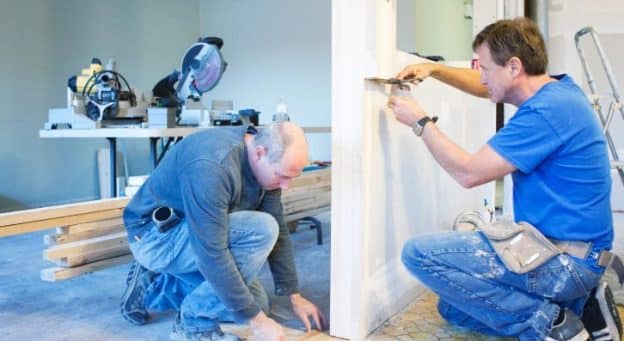
Any time an office build-out (or renovation) is underway, you’ll deal with these risks.
Even if they aren’t that obvious at first glance, rest assured, they’re there. And the consequences of ignoring these risks can greatly influence when a project will be finished, leading to costly overruns, plus the safety of the finished office space might end up being subpar.
In construction work and other similar industries, pneumatic nailers are commonly used and useful machinery for framing, flooring, fencing, and other tasks.
Despite the practical benefits, the tool can be really dangerous if used improperly, and the risk of injury increases significantly. A simple mistake can lead to a catastrophic course of events, such as deep puncture wounds, cuts, nerve damage, infections that can cause sepsis, bone damage, vision damage, amputation, etc. People who work with this type of tool every day and their superiors should be aware of the risk this tool poses and what the proper way to use it is in a safe manner.
In this article, you can read more about the risks of using a pneumatic nailer in construction projects, how to prevent them, and if the injury happens, how to file a claim if it wasn’t your fault.
What Are Pneumatic Nailers?
What exactly are pneumatic nailers? Pneumatic nailers are tools used to drive nails as quickly as possible, powered by compressed air.
It’s a very powerful tool that penetrates all kinds of materials like wood, metal, concrete, plastic, and many more. If used properly, it can speed up the work process compared to using a hammer.
On the other hand, the tool is extremely sensitive, and if you’re not careful enough, you can cause unintended nail discharge that could potentially result in a serious injury. The discharge could hurt other coworkers, not just the ones using the nailer.
Moreover, workers using pneumatic nailers shouldn’t be concerned as long as they are wearing protective gloves, doing routine check-ups, and following the manufacturer’s safety guidelines.
Injury Prevention
Furthermore, supervisors in office-construction projects should ensure proper training for workers depending on the type of tool they are working with and implement appropriate safety protocols in case of an injury.
If not, workers have every right to file a claim and take legal action to get the proper compensation for occupational injury.
In some fast-paced firms, training may be insufficient or improperly conducted due to a lack of attention or a lack of focus on the trainee by every individual worker.
On top of that, construction sites or manufacturing companies that use tools like pneumatic nailers are full of distractions that could contribute to the accident (e.g., noisy environments, uneven surfaces, crowded spaces, poor lighting, etc.).
Additional Safety Protocol
Another critical factor when talking about safety using tools like pneumatic nailers is proper maintenance of the tool, which includes replacing the worn-out parts, cleaning it carefully when needed, documenting any changes after using it for some time, etc.
Workers should have a maintenance schedule and routine that has been proven safe and helpful. Additional barriers on the gloves could also be an advantage, taking into account the force you have to use and the vibrations caused by the equipment.
Workers could experience less fatigue and feelings of dizziness, and adding an additional layer will minimize the risk of an injury even more, making it harder for the nail to penetrate the barrier.
Safety Measures Depending on the Area
Regarding the state where the tool is used, construction sites in some areas have different safety standards and might be less focused on the protocols.
For example, states such as Texas may have construction sites that aren’t strictly regulated, resulting in them not necessarily following the rules, which increases the likelihood of an incident happening.
However, the state of Illinois has very strict, regulated safety standards that include wearing protective equipment, passing the training programs, and other precautionary measures, such as tool handling.
These protective measures definitely reduce the possibility of injury, but even when workers are extremely careful, a small lack of attention can be enough to cause an accident and negatively affect the health of both the worker and their colleagues. Also, when a tool-related injury happens on an office project, the claims process will also differ from state to state. And project investors don’t want to deal with such mishaps.
And it’s not just the legal side of things; it’s the financial risk. Why?
Well, think about it – pneumatic nailer injury claims in Illinois can range anywhere from $28,000 (USD) for minor injuries to $18,000,000 (USD) for catastrophic ones. When you’re heavily invested in the office construction project already, you don’t want this possibly shutting the project down.
To minimize risk, proper training and safety protocols must be in place.
Conclusion
Pneumatic nailers that use compressed air to hammer a nail are much faster and more efficient tools than regular nailers – that’s also the prime reason why they’re used in office construction projects.
But if safety in the work environment isn’t prioritized, employees whose safety is compromised might end up filing a claim. This causes a potential risk for investors, not just as an expense, but something that can potentially stop the office project from being completed.
When both workers’ and employers’ needs are met, that’s when productivity increases, safety standards improve, and a positive work environment is created.
Something that should be followed in any type of project, not just offices.