Modern office design trends in 2026 are defined by a singular shift: the transition from “space as a utility” to “space as a destination.” As businesses grapple with the complexities of hybrid work and employee retention, the office has become a strategic tool for culture and productivity. The most significant trend today is the democratization of high-end architectural planning through spatial intelligence. By leveraging an AI office design free tool, organizations can now visualize adaptive, wellness-centric environments in seconds, ensuring their physical footprint aligns with their operational rhythm.
Key Takeaways
- Adaptive Functionality: The 2026 office is no longer a collection of fixed desks but a series of “dynamic cells” that reconfigure based on real-time team needs.
- Spatial Intelligence: AI-driven layouts are replacing traditional blueprints, allowing for a 70% faster conceptualization phase.
- The Wellness Mandate: Biophilic design and sensory-aware environments have moved from “nice-to-have” to a core requirement for talent retention.
- Frictionless Workflow: Leading platforms are unifying the design process-from initial inspiration to real-world furniture procurement-into a single, seamless flow.
Beyond the Cubicle: The 2026 Evolution of Office Design Trends
The traditional office was designed for oversight; the modern office is designed for “Flow State.” For business owners and facility managers, understanding the current office design trends means recognizing that the physical environment is a direct reflection of corporate ideology. In 2026, we see a move toward “Design that Cares”-an approach that prioritizes the psychological comfort of the employee.
The “One Size Fits All” era is officially over. Current data from global commercial real estate leaders indicates that offices with “flexible zoning” see a 25% higher occupancy rate than those with traditional layouts. This shift is driven by the need for spaces that support deep focus, spontaneous collaboration, and restorative breaks within the same square footage.
Spatial Intelligence: How AI Office Design Free Tools are Leading the Charge
One of the most disruptive modern office design trends is the use of generative AI to solve complex spatial puzzles. Historically, reconfiguring an office required expensive consultants and months of back-and-forth drafts. Today, the barrier to entry has vanished. Utilizing an AI office design free platform allows a startup or a mid-sized firm to upload their floor plan and experiment with hundreds of configurations instantly.
This isn’t just about placing furniture; it’s about “Spatial Awareness.” Modern AI models understand the “physics of work”-the flow of foot traffic, the impact of natural light on screen glare, and the acoustic requirements of open-plan spaces. This technology provides a “safe sandbox” for decision-makers, allowing them to see a high-fidelity version of their future workspace before committing to a long-term lease or a costly fit-out.
The Wellness Mandate: Biophilia and Human-Centric Environments
Employee wellness has shifted from HR policy to architectural core. One of the dominant office design trends in 2026 is the integration of “Tactile Minimalism” and “Biophilic Tech.” This involves more than just adding a few plants; it’s about creating an ecosystem.
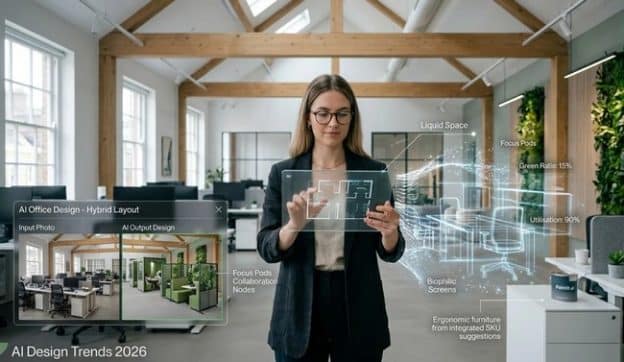
AI tools now help designers calculate the optimal “Green Ratio” for a room, suggesting plant placements that maximize air quality and visual comfort. We are also seeing a rise in “Sensation-Aware” spaces where lighting and acoustics adapt throughout the day to match the human circadian rhythm. By using a unified design ecosystem like Paintit.ai, office managers can visualize these complex wellness layers, ensuring that the “Empathy” pillar of their design is physically manifested in the choice of textures, colors, and organic materials.
The Hybrid Paradox: Reconfiguring Space for a Flexible Workforce
The hybrid model has created a paradox: how do you design for a workforce that is only there 60% of the time? The answer lies in “Liquid Spaces.” This trend focuses on multi-purpose zones that can transform from a town-hall meeting space into a series of private focus pods within minutes.
Spatial intelligence tools allow companies to run “utilization simulations.” Instead of guessing how much space is needed for collaboration, AI analyzes team sizes and work habits to generate the most efficient layout. This “Seamlessness” in the design process ensures that no square foot is wasted, which is critical in high-cost commercial markets. When you can type a prompt and see your “Static Office” transform into a “Hybrid Hub” in real-time, the cognitive load of decision-making is significantly reduced.
The Economic Case for AI-Validated Office Design Trends
For stakeholders and commercial landlords, the return on investment (ROI) of following modern office design trends is clear. A well-designed office isn’t a cost; it’s an asset that accelerates lease deals and reduces turnover.
| Feature | Traditional Design Agency | AI-Driven Design (Paintit.ai) |
| Turnaround Time | 2-6 Weeks | < 60 Seconds |
| Iteration Cost | High (Billable hours) | Included / Instant |
| Visual Fidelity | Variable (2D/3D) | Photorealistic AI Render |
| Furniture Sourcing | Manual catalogs | Integrated SKU Recommendations |
| UX Framework | Fragmented | EIS (Empathy, Intuitiveness, Seamlessness) |
By embracing “Intuitiveness” in the design process, companies can bypass the friction of traditional architectural cycles. The “Flow State” afforded by modern platforms means that a business can move from inspiration to a fully staged, SKU-ready visual without ever leaving the workspace. This efficiency is why office design trends are increasingly leaning toward AI-first methodologies.
From Prompt to Productivity: The New Workflow
The journey of modern office design has become a conversation between human intent and machine precision. The process is simple:
- Contextual Awareness: Upload a photo or blueprint of the existing shell.
- Intent Discovery: Use natural language prompts to describe the vibe-“High-tech industrial lab with soft acoustic zones.”
- Instant Visualization: View the global redesign and use on-image tools to refine specific objects, such as replacing a standard desk with an ergonomic standing station.
- Execution: Access real furniture suggestions that match the render, turning a digital vision into a tangible workplace.
This “Seamless” transition is the hallmark of Paintit.ai, ensuring that the design isn’t just a render, but a relationship with the physical space that evolves over time.
Summary: Designing a Space That Cares
In 2026, an office is no longer just a place where work happens; it is an environment that actively supports the people within it. The most successful modern office design trends are those that prioritize the human experience through the lens of spatial intelligence. By utilizing an AI office design free tool, any organization-regardless of size-can access world-class architectural insights.
Aesthetics should be an accessible form of professional expression. Whether you are a startup looking to define your culture or an established firm reconfiguring for a new era, the goal remains the same: to create a space that matters. By embracing a “Flow State” in design, you aren’t just renovating a room; you are engineering the future of your team’s success.