
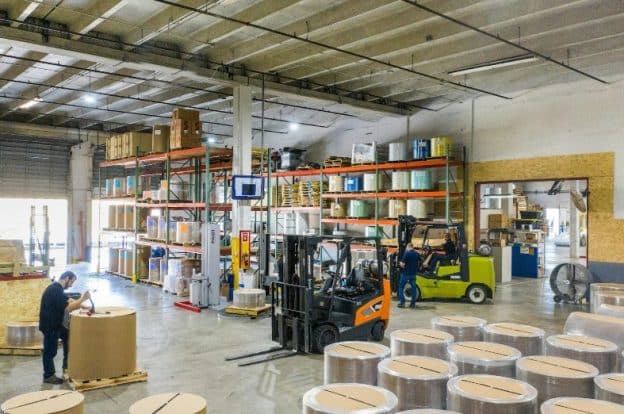
Planning warehouse and office facilities in Australia requires a location-specific approach. The country’s logistics sector is expanding rapidly, driven by e-commerce growth, supply chain restructuring, and infrastructure investment.
The warehouse market alone is projected to grow at over 8% annually through 2035, reflecting sustained demand for distribution space and integrated office facilities.
At the same time, constraints vary significantly by city. Land availability, transport access, labor markets, and infrastructure all shape how warehouse and office facilities are designed and operated.
Sydney: Land Constraints and High-Intensity Logistics Planning
Sydney is Australia’s most constrained industrial market, with strong demand and limited land supply.
Industrial Location Strategy in Sydney
Western Sydney remains the primary logistics corridor, particularly areas like Smithfield–Wetherill Park, which is the largest industrial estate in the Southern Hemisphere and a central hub for manufacturing and distribution.
Location decisions in Sydney are driven by proximity to:
- Major motorways such as the M4 and M7
- Port Botany for import/export logistics
- Growing population centers in Western Sydney
This creates a focus on “last-mile” logistics, where warehouses are positioned close to end consumers rather than ports alone.
Warehouse Design Under Land Pressure
Due to land scarcity, Sydney is increasingly adopting higher-density warehouse models. Multi-level warehouses, previously rare in Australia, are now being developed to maximize land use in constrained urban areas.
Facilities typically include:
- High-clearance internal storage
- Integrated office mezzanines
- Automated picking systems
These designs allow businesses to operate efficiently within smaller footprints, but they increase construction complexity and cost.
Materials and Build Considerations
Sydney’s industrial builds focus heavily on durability and throughput. Steel-frame construction dominates, paired with reinforced concrete flooring designed to handle heavy equipment and continuous movement.
Fire compliance, ventilation, and energy efficiency are also critical due to stricter building standards and higher operational costs.
Brisbane: Growth, Accessibility, and Flexible Industrial Planning
Brisbane offers a different profile. It combines strong population growth with more available land, making it one of the most flexible markets for warehouse development.
Vacancy rates remain relatively balanced, around 5.2%, indicating steady demand without the extreme pressure seen in Sydney.
Choosing Warehouse Locations in Brisbane
Key industrial zones include:
- Trade Coast (near Brisbane Airport and Port of Brisbane)
- South East Queensland logistics corridor
- Emerging inland hubs connected to freight rail
These locations benefit from access to both domestic distribution routes and international shipping.
The expansion of intermodal freight hubs, such as Bromelton, reflects a shift toward integrating rail and road logistics to improve efficiency across longer distances.
Equipment and Operational Setup
Warehouse operations in Brisbane are typically designed for flexibility, supporting a mix of industries from retail distribution to construction logistics.
Equipment planning is a core part of facility design. This includes forklifts, pallet systems, and lifting machinery suited to varied load types. For larger or more complex loads, telehandler hire Brisbane is an ideal option to handle materials across both warehouse and adjacent site operations, particularly during setup or expansion phases.
This approach reduces upfront capital investment while allowing operations to scale based on demand.
Materials and Climate Considerations
Brisbane’s climate introduces additional requirements. Warehouses must account for heat, humidity, and heavy rainfall.
Design responses typically include:
- Ventilation systems to manage internal temperatures
- Weather-resistant cladding materials
- Elevated flooring or drainage systems in flood-prone areas
These factors influence both construction cost and long-term maintenance.
Melbourne: Scale, Efficiency, and High Throughput Logistics
Melbourne is Australia’s largest industrial market by size, with over 30 million square meters of industrial space and one of the lowest vacancy rates nationally.
Industrial Location Clusters
Melbourne’s logistics network is structured around major western and northern corridors, including:
- Truganina and Derrimut in the west
- Epping and Campbellfield in the north
These areas provide access to major highways and proximity to the Port of Melbourne, which handles a significant share of the country’s container traffic.
Warehouse and Office Integration
Facilities in Melbourne tend to operate at larger scale, often combining:
- High-volume warehousing
- On-site administrative offices
- Integrated distribution systems
The emphasis is on throughput. Automation is increasingly used to improve efficiency, with some operators achieving productivity gains of up to 25% through robotics and advanced inventory systems.
Office components are typically positioned within the warehouse footprint, often as mezzanine levels overlooking operational areas.
Construction and Materials
Melbourne’s industrial builds prioritize:
- Large-span structures to maximize usable space
- Heavy-duty flooring for automated systems
- Energy-efficient lighting and systems to reduce operating costs
The scale of these facilities requires careful planning around workflow, access points, and vehicle movement.
Perth: Low Vacancy and Resource-Driven Demand
Perth operates under a different set of conditions, shaped by its role in mining and resource industries.
It has the lowest industrial vacancy rate in Australia, at around 1.6%, reflecting strong demand and limited available space.
Location Strategy in Perth
Industrial development is concentrated around:
- Kewdale and Welshpool (key freight hubs)
- Areas connected to port and rail infrastructure
These locations support both domestic distribution and export-oriented industries.
Warehouse Function and Design
Warehouses in Perth often serve specialized functions, including:
- Storage of mining and industrial equipment
- Handling of bulk materials
- Support for resource supply chains
This affects design requirements, with greater emphasis on durability and load capacity.
Equipment and Material Handling
Operations frequently involve heavy or oversized goods, requiring:
- High-capacity lifting equipment
- Reinforced flooring systems
- Wide access points for large vehicles
Unlike eastern cities, where e-commerce drives demand, Perth’s warehouse sector is more closely tied to industrial and resource activity.
Aligning Warehouse and Office Planning Across Cities
Across all major Australian cities, the integration of warehouse and office facilities is becoming more strategic.
Key factors influencing planning include:
- Proximity to transport infrastructure
- Availability and cost of land
- Workforce access and skills availability
While demand remains strong nationally, the constraints differ. Sydney requires efficiency within limited space, Brisbane offers flexibility and growth, Melbourne focuses on scale and throughput, and Perth operates within a resource-driven framework.
The challenge is aligning facility design with these local conditions rather than applying a uniform approach.
Conclusion: Location-Driven Planning in a Growing Market
Australia’s logistics and warehousing sector continues to expand, supported by e-commerce growth, infrastructure investment, and evolving supply chains.
However, successful warehouse and office planning depends on understanding the specific dynamics of each city.
From land constraints in Sydney to growth opportunities in Brisbane, each market requires tailored decisions around location, design, equipment, and materials.
Facilities that align with these realities are better positioned to operate efficiently, adapt to demand, and remain competitive in a rapidly evolving logistics landscape.
