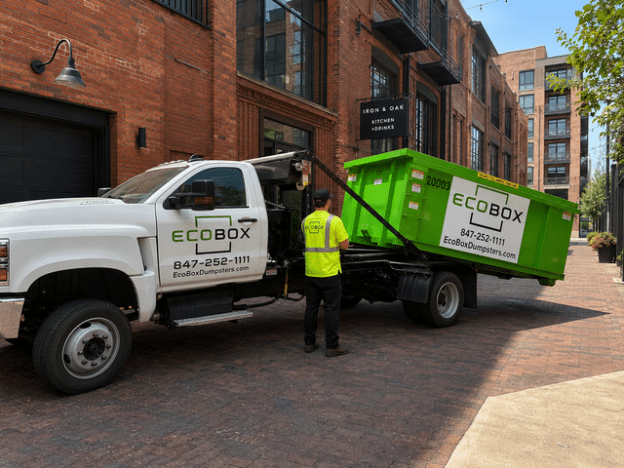
A practical guide for property managers, building owners, contractors, and renovation teams across Chicago, the North Shore, Lake County, and Northern Illinois
Commercial renovation projects rarely get delayed because someone forgot that there would be debris. They get delayed because waste removal is treated as a minor logistics detail rather than part of the project plan. On an occupied office property, retail center, medical suite, multifamily building, or mixed-use property, the location and timing of a dumpster can affect deliveries, tenant access, parking, safety, and the pace of work.
That challenge is especially noticeable across Chicago and the surrounding suburbs, where tight sites, shared parking lots, busy access drives, municipal rules, and active tenants can leave little room for improvisation. A better approach is to make waste planning part of pre-construction coordination, just like staging, deliveries, temporary protection, and building access.
1. Decide where the container will go before work begins
The best dumpster location is not simply the closest open space to the work area. It has to work for the property, the contractor, the hauling truck, and the people who still need to use the site.
Before delivery, walk the property and identify a placement area with a stable surface and enough clearance for safe delivery and pickup. Consider loading docks, fire lanes, overhead wires, landscaping, parked vehicles, dumpsters already serving the property, and the delivery truck’s turning radius. If a container needs to sit on a public street, sidewalk, or municipal right-of-way, confirm local requirements before scheduling delivery, as permit rules vary by municipality.
2. Match the container to the debris, not just the project size
A 10,000-square-foot interior project does not automatically require the largest available container, and a smaller project can generate surprisingly heavy debris. Drywall, framing lumber, fixtures, flooring, cabinetry, masonry, roofing materials, and clean-out contents all have different volume and weight characteristics.
The practical question is not only, “How much material will we remove?” It is also, “What will that material weigh, how quickly will it accumulate, and how much room do we have for a container?” Getting those answers early makes it easier to choose an efficient container size and avoid unnecessary swaps or overloaded loads.
3. Build pickup and swap timing into the construction schedule
A full dumpster sitting on site is more than an inconvenience. It can push debris into staging areas, hallways, loading zones, or work spaces that crews need for the next phase. That is why experienced project teams think about the waste stream alongside the construction schedule.
For example, demolition may create a large volume in the first few days, while later phases generate smaller amounts of packaging, drywall scraps, flooring, and finish materials. If the early demolition phase is expected to fill a container quickly, schedule the likely swap before it becomes a bottleneck. For longer commercial projects, coordinate pickups around major demolition, flooring removal, tenant turnovers, and other predictable peaks in debris.
4. Protect tenant, customer, and contractor access
In an occupied commercial property, waste removal must coexist with daily operations. A container that blocks customer parking, loading access, a service entrance, or a tenant’s preferred route can create complaints even when the construction work itself is proceeding smoothly.
Property managers should coordinate the placement plan with the general contractor and, when appropriate, communicate temporary parking or access changes to tenants in advance. For multi-tenant properties, consider when deliveries occur and whether waste-hauling activity can be scheduled outside the busiest periods. A few minutes of coordination can prevent a week of friction.
5. Separate prohibited and specialty materials before loading
A general construction dumpster is not a catch-all disposal solution. Paints, solvents, chemicals, batteries, electronics, asbestos-containing materials, tires, refrigerants, and other regulated or hazardous materials may require separate handling. Certain dense materials can also have special loading or container requirements.
The simplest way to avoid problems is to identify questionable materials during the pre-construction walk-through. Ask the hauling provider what is accepted before crews begin loading. This is particularly important in older commercial and multifamily buildings where renovation work may uncover materials that were not visible during initial estimating.
6. Choose a hauling partner that fits constrained urban and suburban sites
Chicago-area properties vary widely. A suburban office campus may have abundant pavement and multiple access points, while a North Shore mixed-use property or an older neighborhood commercial building may offer only a narrow driveway or limited rear access. The equipment used to deliver a dumpster matters.
Local providers such as EcoBox Dumpsters serve homeowners, contractors, property managers, and businesses across Northern Illinois with compact roll-off containers and delivery equipment designed for tighter residential and commercial sites. For commercial renovations, working with a provider that understands local access conditions can make placement and pickup substantially easier.
When evaluating a hauler, ask about delivery footprint, container dimensions, scheduling, allowable materials, weight limits, extension options, swap availability, and what information the driver needs before arriving. The goal is not simply to get a dumpster. It is to integrate waste removal into the project without disrupting the property.
7. Treat waste removal as a project-management item
The most effective waste plans have a clear owner. Someone should know who schedules the container, who can request a swap, who checks the load before pickup, and who communicates changes to the property manager. Without that ownership, a simple operational issue can turn into a delay.
For projects that generate ongoing debris, arranging a construction dumpster rental as part of the pre-construction plan can help contractors coordinate container size, placement, delivery timing, and anticipated swaps before crews mobilize. That is much more efficient than waiting until demolition debris begins accumulating on site.
A small planning decision with an outsized impact
Waste removal is rarely the most complicated part of a Chicago-area commercial renovation, but poor planning can make every other part more complicated. A container placed in the wrong location can interfere with tenants. A pickup scheduled too late can slow a crew. The wrong container can create avoidable costs and handling issues. Unidentified specialty materials can stop disposal altogether.
By deciding placement, debris type, container size, access, pickup timing, and responsibility before work starts, property managers and contractors can eliminate many of those problems. It is a straightforward addition to pre-construction planning, and one that helps keep the property cleaner, the job-site safer, and the renovation moving.