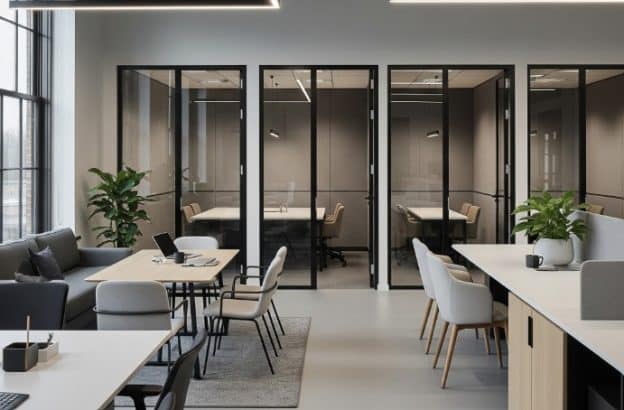
The Coworking Market Is Growing Up
The future of coworking spaces is not beanbags, free coffee, and startup slogans on glass walls. That version is tired. The next phase looks more practical: enterprise flex leases, smaller satellite offices, project rooms, better acoustics, stronger privacy, and locations built around hybrid teams rather than full-time desk renters. The market is still growing, but the hype has become more disciplined. Companies want flexibility because headcount, office attendance, and project cycles no longer move in straight lines.
Hybrid Work Made Fixed Offices Look Heavy
The fixed office lease feels expensive when half the desks sit empty three days a week. Hybrid work exposed that waste. A company may still need a physical base, but it may not need a full-floor commitment for ten years.
JLL argued in 2026 that flexible office space helps companies match real estate to headcount swings, special projects, and market entry. That is the core change. Coworking is becoming part of corporate cost control, not just freelancer culture.
Flexible Office Trends Are Moving Upmarket
The strongest flexible office trends point toward better infrastructure. Teams want soundproof call rooms, stable internet, meeting rooms that actually work, secure access, and spaces that do not look temporary. Design matters, but operations matter more.
CBRE’s 2025 European flex market update noted that the average allocation of flexible space rose from 12% in 2024 to 21% in 2025 among surveyed occupiers. The U.S. market is showing a similar shift. JLL reported that flexible workspace now accounts for roughly 3% of total U.S. office inventory, but demand is growing fast, with enterprise users making up more than 40% of new flex commitments. In major U.S. cities, flex penetration is even higher: Manhattan, San Francisco, and Miami all saw double‑digit year‑over‑year increases in enterprise flex leasing. That momentum explains why landlords increasingly treat flex as a core product line rather than an optional amenity.
Cricket, Work Breaks, and Second-Screen Habits
Hybrid workdays create short pockets of attention. A person may move from a client call to a café table, glance at a cricket score, then return to a shared meeting room before the next session starts. In the UK, where cricket remains one of the most widely followed sports, this quick check‑in behavior is even more common. In that pattern, cricket online betting becomes part of a broader live‑data habit rather than a separate ritual. The activity works best when users read the match state carefully: pitch wear, run‑rate pressure, wicket timing, bowling changes, and live odds movement all influence the value of a market. A clear stake limit helps keep the habit controlled, especially when work breaks are short and decisions can become too reactive.
The Office Is Becoming a Service
The old office sold square footage. The new one sells readiness. A team can arrive Monday, use a project room for four weeks, scale up for a launch, then reduce seats without tearing up a lease.
That service model changes expectations. Operators now compete on booking systems, hospitality, privacy, IT support, location density, and contract simplicity. A beautiful lounge helps, but a broken video call kills trust faster than ugly furniture.
What Companies Will Actually Buy
Coworking demand is splitting into clear use cases:
| Need | Workspace Format | Why It Matters |
| Hybrid team days | Bookable team rooms | Keeps collaboration scheduled |
| Market entry | Short-term private office | Avoids long lease exposure |
| Client work | Premium meeting rooms | Improves presentation quality |
| Remote employee support | Local coworking passes | Reduces isolation |
| Project sprints | Temporary war rooms | Supports fast execution |
This is why broad “open desk” products are losing some shine. Teams want purpose-built space.
Platforms, Workdays, and Mobile Access
A modern workday is fragmented. People move between office apps, ride‑hailing, lunch orders, sports scores, and payment tools without thinking of them as separate behaviors. For sports fans, a platform such as MelBet Bangladesh fits naturally into that mobile‑first rhythm because it delivers quick access to cricket markets, live odds, and event statistics in the same seamless way other daily apps deliver information. The value is not in speed alone; it comes from being able to compare fixtures, read market depth, and avoid random picks. Good sportsbook use looks closer to disciplined data checking than impulse tapping
Design Will Decide Loyalty
Gensler’s 2025 workplace survey covered more than 16,800 full-time office workers across 15 countries. The message was clear: workers want offices that support different work modes, not one desk for every task. Coworking operators that understand this will keep users longer.
The next premium feature may not be the rooftop. It may be silence. Good chairs, clean bathrooms, private rooms, natural light, phone booths, and reliable cooling will beat gimmicks.
The Market’s Hard Truth
Coworking is not immune to weak economics. Operators still face rent pressure, fit-out costs, churn, and uneven occupancy. The winners will be those with disciplined locations, enterprise demand, strong utilization data, and contracts that protect margin.
The future of workspaces is not fully remote or fully office-based. It is a selective presence. People will come in when the room gives them something the home desk cannot.