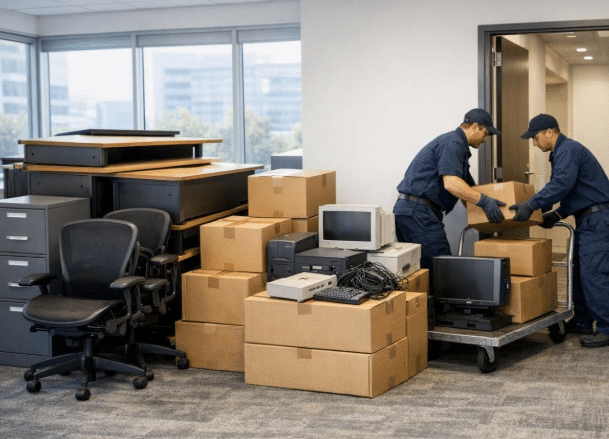
Businesses collect a lot of furniture, equipment, paperwork and other waste as time goes on. When a company moves to a smaller office, shuts down or updates its space, businesses find that getting rid of these things can be a big challenge. Without a plan, this process can disrupt workers. Take away time that could be used for regular work.
A professional office clearance is a sensible approach for firms to swiftly clear out undesirable objects and prepare their premises for their next use. Whether it’s desks and chairs or computers, cabinets or general rubbish, having a clear method for clearing these items may make relocation, renovation or closure much easier, as well as allowing businesses to manage their waste sustainably.
What is the definition of office Clearance?
Unwanted furniture, equipment, waste, and other items are eliminated from a commercial property during office clearance. Depending on the extent of the premises and the nature of the business, the precise scope may differ. Removing a few workstations and chairs may suffice for a small office, while larger clearances may require removing multiple rooms, storage areas, kitchens, and meeting spaces.
The property can be evaluated by a professional clearance team, which can also ascertain the quantity of items that require removal and coordinate reasonable labour and transportation.
When Is Office Clearance Required for Businesses?
An office clearance may be required for a number of reasons. Moving to a building is a common reason for an office clearance, especially when the current furniture does not fit into the new space. Businesses may also need an office clearance permit when they shrink their office, close a location, or remodel an office. Replace old furniture and equipment. Landlords often organise office clearance when they prepare to rent out a space that has had tenants.
What Can Be Removed?
The acceptable products will vary from clearance provider to clearance provider, but common office clearance services include desks, office chairs, tables, filing cabinets, shelving, cupboards, storage units and other equipment. Companies may also have to take away computers, monitors, printers, telephones and other electronic devices. Some kitchen equipment, unwanted stationery, cardboard and general waste may also be included.
Organizing an Office Clearance
Good planning will make clearance faster and less disruptive. Start by identifying everything that needs to be removed and separate it from equipment or documents that must be retained for clearance.
Creating an inventory will help managers understand the size of the clearance job.
Advantages of Employing Professionals
- Make a list so you can see how many items there are and what kinds each item belongs to.
- Take out desks, chairs, cabinets, shelves and other office furniture that is not needed.
- Plan the way to take out computers, printers, screens and other equipment.
- Set a time for the cleaning that’s easy for the business and does not cause problems.
- Get experts to move heavy, big and hard-to-move items.
- Decide on the way to get rid of things and try to reuse or recycle as much as possible.
- Keep company information safe by handling papers and electronic devices carefully.
- Ask for a price and make sure you know what services and costs are included.
- Getting professionals to do the cleaning saves time for the employees and lets them work on their tasks.
Responsible Waste Management
When clearing an office, responsible disposal should be top of mind. Many office supplies can be reused or recycled. Furniture in acceptable condition may be reusable. Materials such as cardboard, metals, and some electronics may often go into proper recycling streams.
Office Furniture and Equipment
Office furniture can take up a lot of space in a clearance. Desks, chairs, cabinets and shelves can be big and hard to move without the right tools. Professional teams can remove these items quickly while ensuring they don’t damage the space.
How Much Does Office Clearance Cost?
The cost of an office clearance can change based on the amount and type of waste. It also depends on the number of personnel required, access to the property, transportation needs, and the waste disposal method. In general, larger offices necessitate additional personnel, equipment, and time than smaller offices.
Final Thoughts
Office clearance does not have to be disruptive. With professional support, office clearance can be done precisely, helping businesses dispose of surplus furniture, equipment, and refuse while preparing their premises for relocation, renovation, or closure. Office clearance services can support responsible waste management, reduce physical exertion, and save time, helping businesses focus on the next phase of their operations.