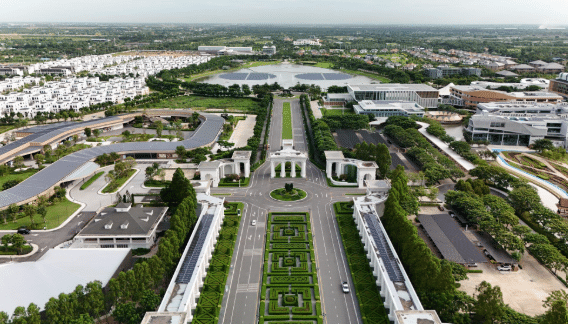
Gated communities have become one of Thailand’s most dynamic real estate development trends, blending modern convenience with heightened privacy and security. As urban centers expand and lifestyle expectations evolve, developers are increasingly designing master-planned neighborhoods that offer residents exclusivity, well-managed amenities, and a more controlled living environment. This shift reflects not only changing buyer preferences but also Thailand’s broader push toward sustainable, community-focused development across both metropolitan and resort destinations.
A real estate developer should focus on understanding market demand, securing the right land, structuring strong financing, and creating designs that meet both buyer expectations and regulatory requirements. Success depends on coordinating construction, marketing, and long-term property management to deliver projects on time, on budget, and with lasting value.
Buyers evaluating a gated community in Thailand tend to focus on the visible things: the gate itself, the guards, the clubhouse, the landscaping. Fewer ask a more basic question: who has authority over the estate once the developer has sold the homes and moved on, and what legal entity collects fees and enforces the rules everyone agreed to. Thai law gives that entity a specific legal form and understanding it explains a lot about what buying into a gated community actually commits a homeowner to.
The Juristic Person, Explained
Under the Land Allocation Act B.E. 2543 (2000), once a developer has sold more than half of a subdivided estate’s plots, the framework provides for homeowners to establish what Thai law calls a housing estate juristic person, the closest domestic equivalent to a homeowners’ association. Formation is not automatic. Purchasers holding at least half of the estate’s sub-lots must pass a resolution to establish the entity, appoint a representative, and submit an application, along with articles of association, to the local Land Office for registration. Once registered, the entity has full legal status, with a homeowner-elected executive committee responsible for day-to-day operations.
This structure has a longer history than most buyers realize. The current framework replaced Revolutionary Council Announcement No. 286 of 1972, Thailand’s original land allocation law, meaning the underlying model of resident-governed housing estates has existed in some form for more than half a century.
What the Committee Can Actually Do
Once established, a housing estate juristic person has real, legally defined powers. It can levy fees from every homeowner to maintain and manage shared facilities, roads, security, and common utilities. It can take legal action on behalf of residents, provided at least ten members support the action, where a matter affects shared rights or interests. It can also adopt and enforce estate regulations, which in practice can extend to restrictions on renovations, pet ownership, or short-term rentals, depending on what a given community’s articles of association actually specify. Major decisions of this kind require a resolution passed at a general meeting, rather than being left to the committee’s unilateral discretion, which meaningfully limits how much any single body can impose on residents without their collective agreement.
What This Actually Means for a Buyer

Buying a house inside a Thai gated community means entering a form of collective governance, not simply paying a premium for a gate and a security guard. An owner remains individually responsible for the structural integrity, private utilities, and upkeep of their own home, while separately paying into, and being bound by, the juristic person for everything shared across the estate. Because each community’s articles of association set specific rules, fee structures, and committee powers, they vary meaningfully from one development to the next. Reviewing those documents before purchase, rather than assuming one gated community operates the same way as another, is a more useful diligence step than most buyers realize.
Large-scale communities are not exempt from this framework simply because of their size. A development such as Reignwood Park in Lam Luk Ka, Pathum Thani operates under the same Land Allocation Act structure as any other qualifying housing estate in Thailand, with its own homeowner-linked governance overseeing shared facilities across the property. The legal mechanics behind the gate are the same, whatever scale sits behind it.
For more information about Reignwood Park and its residential collections in Lam Luk Ka, Pathum Thani, visit reignwoodpark.com or contact the team at saleoffice@reignwoodth.com / +66 (0)2 978 8888.