
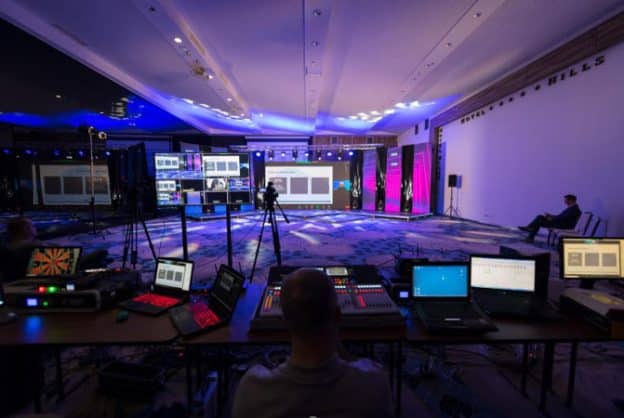
The commercial property market has a habit of describing tenants by what they used to be. Call center. Back office. Light industrial. The categories persist long after the work within them has changed shape, and as a result, some of the most demanding occupiers in the market continue to be shown space designed for a business that no longer exists.
Live-streamed entertainment is the clearest current example. Over roughly a decade, an entire production industry has grown up around content broadcast continuously, watched by substantial audiences, and generated in real time by people standing in a room. That room is a commercial property problem, and it is not a small one. Anyone advising landlords, or hunting space on behalf of a studio operator, is dealing with requirements sitting somewhere between a television facility, a data center, and a secure cash-handling site.
A Tenant Class That Did Not Exist in 2015
Live content used to be made in a small number of very expensive buildings owned by broadcasters. Distribution was the bottleneck, so production concentrated. Once distribution became effectively free, production dispersed, and a long tail of studio operators appeared to serve it.
The category now covers Esports production, live commerce and shopping streams, corporate and investor broadcast, remote education at scale, and the live dealer sector of online gaming. What these share is not subject matter. It is an operating profile: continuous or near-continuous transmission, an unforgiving tolerance for downtime, staff working on-site shift patterns, and a physical set that cannot simply be picked up and carried elsewhere when a lease expires.
Property professionals tend to meet these tenants late, usually once a deal is already in trouble because the building cannot deliver something the tenant assumed was standard.
What the Broadcast Floor Actually Demands
Start with the set. A live production floor is not an office with cameras in it. It is a fixed installation of lighting rigs, camera positions, monitor walls, and acoustic treatment, all of which are hung, bolted, or bonded to the building’s structure.
Every hand dealt in the live gambling sections of licensed operators such as MrQ, which has run slots, bingo and live tables since 2018, is dealt in a room somebody had to lease, fit out and power. Those rooms hold multiple tables, each with its own camera array and lighting state, staffed in rotation around the clock. The same logic governs a shopping channel or an Esports arena. The tenant is buying a volume of controlled, instrumented space, and the fit-out cost per square foot dwarfs that of any conventional office letting.
Two structural specifications follow immediately. The first is floor-to-ceiling height, because lighting rigs and trusses must sit above the eye line and out of shot. The second is floor loading, because equipment, cable trays, and set construction are heavy and not distributed the way desks are.
Power, Cooling, and the Cost of Silence
Power is the constraint that kills most deals. A studio floor draws heavily and continuously: lighting, cameras, encoders, racks, and the cooling needed to remove the heat all of that generates. A building with a supply sized for general office use will not carry it, and upgrading an incoming supply is a matter for the distribution network operator, on their timetable rather than the tenant’s.
Redundancy compounds the problem. Continuous broadcast means an uninterruptible power supply for the critical load and, in most serious installations, a generator serving as a backup. Both need somewhere to live: plant space, ventilation, fuel storage, and the consents that go with them.
Then there is silence. Live audio is unforgiving, and the ambient noise floor of an ordinary commercial building sits far too high. Isolation from adjacent tenants, the plant, traffic, and the building’s own services is expensive and has to be designed in from the beginning. A landlord who has let the neighboring unit to a gym has, without realizing it, made the space unlettable to a studio.
Security as a Lease Term
Live gaming studios carry compliance obligations most landlords never encounter. Access is controlled and logged. Cameras cover the floor continuously for audit rather than for broadcast. Equipment is subject to chain-of-custody procedures, staff is vetted, and the operator answers to a regulator with the right of inspection. In Britain, those conditions flow from the licensing framework administered by the Gambling Commission, and they do not bend to accommodate a building.
Practically, that means secure single-tenancy floors, dedicated risers, controlled loading access, and lease terms permitting alterations a standard institutional lease would refuse. It also means reinstatement clauses deserve careful thought at the outset, because a fully fitted studio cannot be stripped back to shell in a fortnight.
Comparable considerations apply, at lower intensity, to financial broadcasting, pharmaceutical marketing, and anything else in which the content being produced is itself regulated.
Why Landlords Should Pay Attention
The case for courting these tenants is straightforward. Fit-out capital of this magnitude produces a genuinely sticky occupier. Studios do not relocate casually, because relocation means rebuilding the installation and, for a live product, going dark while they do it. That translates into long leases, low churn, and a powerful incentive to renew.
The stock suiting them is frequently stock that suits nobody else. Tall industrial units, former telephone exchanges, old print works, secondary office buildings with heavy incoming power and thick floors. Assets struggling to attract conventional office demand can prove extremely attractive here, provided the landlord will discuss alterations honestly rather than defending a template lease.
The binding constraint is almost always electrical capacity, and it is knowable in advance. A landlord with a clear statement of available supply, plus the cost and lead time to increase it, holds the single most useful document in the negotiation.
Reading the Next Ten Years
Live production is not a fad destined to consolidate back into a handful of broadcast centers. Distribution stayed cheap, audiences stayed fragmented, and the economics favor many rooms over a few. The tenant profile will broaden further to include telehealth, live shopping, remote officiating, and professional training at scale.
For anyone matching occupiers to buildings, the useful shift is to stop asking what sector a tenant belongs to and start asking what the room has to do. Power, height, loading, silence, security. Those five questions sort the market faster than any sector classification, and they are the questions the studio operator has already asked before walking through the door.
Main Image by dotshock on Magnific
