
(and How to Catch Them Before You Sign in 2026)
Signing a lease is one of the biggest financial commitments a business makes, and most companies do it only a handful of times in their entire life, while the landlord across the table does it every week. That imbalance widens the moment the lease, the landlord, or the building’s governing documents are in a language your team does not read fluently. More businesses now lease space across borders, take over leases first drafted abroad, or sign with landlords whose master documents were written in one language and translated for your benefit. The translated version is the one you read. It is not always the one that governs.
A lease clause does not have to be mistranslated in any dramatic way to cost you. It only has to be ambiguous. Courts treat an ambiguous clause as fertile ground for litigation, and once a judge decides a term is open to more than one reasonable reading, the meaning of your obligation gets decided by someone other than you. Seemingly minor language issues create real business problems, and a single word can carry far more legal weight than the parties realize. When that ambiguity slips in as a clause moves from one language to another, you can end up bound to a reading you never agreed to. These are exactly the kind of legal considerations that come with any commercial lease worth understanding before you sign.
Here are seven lease clauses where a small shift in wording between languages does the most damage, why each one matters, and a practical way to catch the problem before your signature makes it permanent.
1. The rent escalation clause
Escalation language decides how much more you pay every year, and it is packed with terms that do not survive a careless rendering: base year, expense stop, pro rata share, consumer price index. A clause that ties your increase to the growth in operating expenses over a base figure is a very different financial animal from one that charges you a share of total operating expenses every year. If a translated version quietly blurs “increase over base” into “share of total,” you can absorb costs you never modeled. OfficeFinder’s office lease checklist runs through the exact escalation questions to pin down, and every one of them depends on words meaning the same thing in both languages.
2. The break clause and the termination clause
This is the classic trap. A termination clause and a break clause can look interchangeable to anyone working quickly, yet they carry different legal implications and swapping one for the other changes who can end the lease, when, and at what cost. As one legal translation team notes, a poorly rendered termination clause can be read as a break clause, with entirely different consequences. A clause that hands the landlord a right you assumed was yours is not something you can wave away after signing. Read termination, notice, and early-exit language with particular suspicion whenever it has crossed a language boundary.
3. The repair and maintenance clause
Good order and condition. Ordinary wear and tear. Structural portions. Reasonable repair. These phrases decide whether you hand the space back with a coat of paint or a six-figure restoration bill. The word reasonable alone is a well-known source of disputes because it is vague by design, and vagueness only multiplies when a clause is carried into another language where the closest available word is broader or narrower than the original.
4. The operating expenses clause
Triple net, gross, modified gross, and pass-through language determine which running costs land on you and which stay with the landlord. A single misplaced qualifier can move an entire category of building expenses onto your ledger. Because these clauses often stack several defined terms into one sentence, they are unusually fragile in translation: get one definition slightly off and the arithmetic of your monthly obligation changes without anyone noticing, until the first reconciliation statement arrives.
5. The governing language clause
This is the clause most tenants never think to check, and the one that decides which version of every other clause actually counts. A prevailing language clause, also called a governing language or language supremacy clause, states that if the translations ever conflict, one specified language controls. If that clause names a language your team does not read, the document you carefully reviewed is not the document a court will enforce. In one international dispute, an entire jurisdiction question turned on whether a single word rendered as “execution” meant signing the contract or performing it, because the original-language word was far less ambiguous than its English version. Two readings, one signature, years of litigation.
This clause is also where the weakness of a quick single-engine check shows up most clearly. Paste a clause into one AI engine and you get a single answer delivered with total confidence, with no way to know whether a different engine would have read it differently. Individual top-tier AI models distort or fabricate content somewhere in the range of 10 to 18 percent of the time on translation tasks, and on a binding clause you cannot see which of those you just landed in.
6. The renewal and option clause
Renewal terms, options to extend, and first rights of refusal are only as good as their trigger conditions: the notice window, the method for setting option rent, the definition of the expansion space. If an option says the renewal rent will be “as agreed by the parties,” it may not be enforceable at all. These conditional, time-sensitive clauses are easy to soften in translation, and a softened trigger can quietly cost you the flexibility you negotiated for. The same care applies to the exit and modification terms common in flexible workspace lease agreements.
7. The use and exclusivity clause
The use clause defines what you are actually allowed to do in the space, and an exclusivity clause protects you from a direct competitor moving in next door. Both hinge on precise scope language, the kind that lists what is permitted and, by implication, what is not. When that scope is translated too broadly or too narrowly, you can find your business restricted in ways you did not expect, or your protection quietly narrowed to nothing.
The check that catches these before you sign
Notice the pattern across all seven clauses. The danger is rarely that one word is obviously wrong. It is that a single reading looks perfectly fine on its own, with nothing to compare it against. One opinion, human or machine, cannot flag its own blind spot.
That is the case for checking a clause against many independent engines at once rather than one. Run a clause through a group of AI models and line up the outputs side by side, and the sentences where they all land in the same place are the ones you can trust. The sentences where they scatter are your early warning that the wording is ambiguous. The disagreement is the signal. This is how MachineTranslation.com by Tomedes approaches high-stakes text: it runs a clause through 22 AI models at once and surfaces the reading the majority land on, an architecture the company reports cuts the risk of a critical error by roughly 90 percent against trusting a single engine. The effect is visible in a side-by-side of a Spanish business contract clause across AI models, where the points of model-to-model divergence are precisely the phrases a careful reviewer would stop on.
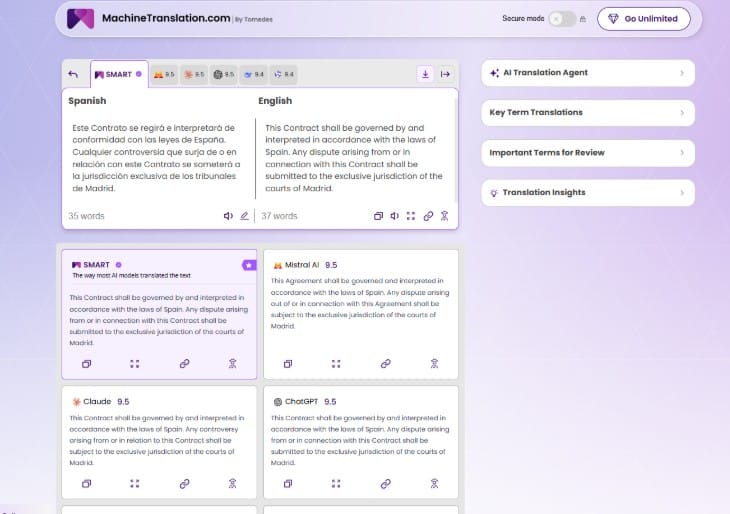
Source: https://www.machinetranslation.com/t/spanish-business-contract-clause
“A binding clause is exactly where one model’s interpretation should never stand alone. The disagreements between models are the early warning. The reading they share is the one you can sign.”
For a lease you are about to execute, that cross-checked draft is the starting point, not the finish line. The version you sign should still get a human review, ideally from someone who reads the governing language and knows lease terminology. Convergence across models tells you where to look. A qualified human reviewer tells you what to do about it. Used together, they move you from “we think this is what the clause means” toward something much closer to certainty.
Before you sign
None of this replaces good representation. The most reliable protection against a costly clause is still an experienced tenant rep, and where the stakes justify it a lawyer who reads the governing language, negotiating on your side of a table the landlord sits at far more often than you do. What cross-checking adds is the thing that makes that representation sharper: an early, clear view of exactly which clauses deserve a second look before anyone signs.
If you are weighing a lease now, especially one that crossed a language boundary before it reached you, start with the seven clauses above, pressure-test the wording, and work with a local tenant representative who knows your market. The best time to resolve an ambiguous clause is while it is still a question. After signing, it becomes a dispute.
