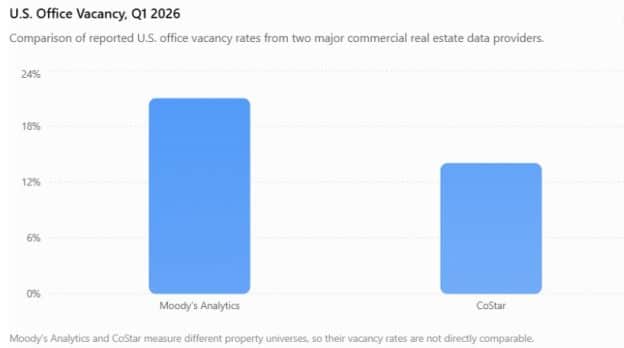
Two firms conducted identical studies of the office market in the United States this spring. One reported that 21% of it was vacant. The other reported that 14%.
Both are reliable. Neither made an error. According to Moody’s Analytics, the nationwide office vacancy rate was record-breaking at 21% in Q1 2026. CoStar reported it at 14.0%.
CoStar’s national director of office analytics explained the spread without drama: the two firms track a different universe of properties. CoStar counts smaller buildings, tertiary markets, and medical office, which all run tighter than the big towers.
Seven percentage points. In residential real estate, a gap like that would be a scandal. In commercial, it’s a Tuesday.
That gap is the fastest way to understand what a multiple listing service website is, what it isn’t, and why the differences cost people real money.
The residential MLS works because nobody gets to opt out
A residential MLS is a database plus a rulebook. The rulebook is the part that matters.
The Real Estate Standards Organization tracked 489 MLS systems in the United States as of July 2026, a number that shrinks most years as regional systems merge. Each one covers a defined territory, and each one enforces the same basic bargain: if you’re marketing a home publicly, that home goes in the database where every other participant can see it.
NAR’s Clear Cooperation Policy, live since January 2020, gives you one business day. Put a sign in the yard or post it to Instagram, and the clock starts.
In March 2025, NAR softened the edges with a policy called Multiple Listing Options for Sellers, which created “delayed marketing exempt listings” and had to be implemented by every MLS by September 30, 2025. A seller can now hold a property back from public syndication for a window their local MLS defines. Even then, the listing still has to go into the MLS where other agents can see it, and the seller has to sign a disclosure saying they understand what they’re giving up.
Read that structure closely, and you’ll see what actually creates the value. Not the software. The obligation.
Because participation is mandatory, a buyer’s agent in Charlotte can hand you a list and say, with a straight face, this is everything. Because it’s mandatory, the sold data is close to complete, which is why residential appraisals and Zestimates work as well as they do. Because it’s mandatory, the vacancy or inventory number one firm publishes looks like the number every other firm publishes.
Pull that obligation out and the whole thing changes shape. Which brings us to your side of the market.
Commercial has no equivalent rule, and it never has
The closest cousin is the Commercial Information Exchange. NAR authorizes two commercial services, the CIE and the Commercial/Industrial MLS, and publishes a comparison of how they differ. CIEs are run by local associations, tend to appear in larger metros, and function as information exchanges rather than cooperation agreements. A CIE never carries an offer of compensation between brokers. That gets negotiated privately, deal by deal, and always has.
Participation is voluntary. That single word does most of the damage.
A landlord with 40,000 square feet coming available in eighteen months has no obligation to tell anyone. A broker sitting on a quiet sublease at a distressed tenant has every reason to work it inside their own firm first. Neither is behaving badly. There’s simply no rule requiring otherwise, and there’s often a commercial incentive pointing the other way.
So the commercial “market” is really four overlapping markets: national subscription platforms, local CIEs, private broker networks, and the enormous pile of space that isn’t listed anywhere at all.
The seven differences that change how you search
| Residential MLS | Commercial listing world | |
| Who runs it | 489 regional MLS systems, association- or broker-owned | Local CIEs, national subscription platforms, private broker networks |
| Participation | Required within one business day of public marketing | Voluntary, always |
| Price shown | The asking price is the number | The quoted rate is an opening position |
| Unit of comparison | The whole home | Dollars per square foot per year, and the square footage itself is arguable |
| Broker compensation | Negotiated separately since the 2024 practice changes | Negotiated outside the service, always has been |
| Data hygiene | Status changes enforced, fines are real | Little enforcement, stale listings are routine |
| Public access | IDX feeds push listings to consumer portals | Fragmented, the good data sits behind subscriptions |
Four of those rows deserve more than a table cell.
The quoted rate tells you almost nothing
A home listed at $625,000 is asking $625,000. An office suite quoted at $34 per square foot might land anywhere from $34 with no concessions to $34 with eight months of free rent, a $70 per foot improvement allowance and a fixed 2% escalation, which is a wildly different deal.
The headline number is the least informative part of a commercial listing. Landlords protect face rate because it props up the building’s valuation, then give the value back in concessions that never show up in any database.
The square footage is negotiable too
Rentable versus usable is where new tenants get surprised. You lease rentable square feet, which includes your share of lobbies, corridors, and restrooms. You occupy usable square feet. The gap is the load factor, and it commonly runs 10% to 20% depending on the building’s shape and the BOMA standard applied.
Two suites quoted at the same rate can differ by a fifth in actual usable space. Nobody flags this for you.
Nobody cleans up after the deal closes
Residential MLSs fine agents for leaving a sold listing active. Commercial platforms mostly don’t, because there’s no membership rulebook behind them. Listings sit online months after the space is gone. Contact names belong to brokers who changed firms in 2024.
This is the single most underrated frustration for tenants doing their own search, and it’s the one nobody warns you about.
Comps are a favor, not a feed
Residential closed prices are public and fed back into the system. Commercial lease terms are confidential. Effective rent on the deal signed two floors above you is known to maybe six people, and you get it by knowing one of them.
That’s not a fixable data problem. It’s how the asset class works.
What this means if you’re a small business looking for space
Say you’re a 14-person firm with a lease expiring in ten months, and your instinct is to open a browser and start comparing.
Here’s what actually helps.
Give yourself more runway than feels reasonable: Nine to twelve months for a small office, more if you need construction. Landlords read a short timeline as leverage.
Understand who pays whom: If your instinct is to start on a Google real estate listings the way you would house hunting, the commercial version of that experience runs through people rather than through a database. Tenant reps are compensated out of the commission the landlord is already paying, which means representation on your side usually costs you nothing directly. Landlords negotiate leases constantly. You’ll do it maybe four times in your working life.
Check zoning before you fall in love with a space: The SBA’s guidance on picking a business location covers this, and it catches people every year, especially in mixed-use conversions and older buildings where the previous use was grandfathered.
Ask what isn’t listed: In a market with vacancy anywhere near 14%, the space that fits you best is frequently a sublease or a quiet availability that never got marketed. That inventory is only reachable through someone who works the submarket daily.
Price the whole term, not the rate: Build a simple net effective rent calculation across all sixty months, including free rent, escalations, the improvement allowance and your share of operating expenses. Two deals quoted a dollar apart routinely land three dollars apart on that math.
What it means for brokers and investors
If you’re on the professional side, the fragmentation is the business model. Your local knowledge has value precisely because no database has replaced it.
The risk is assuming your data source is the market. It’s a sample of the market, and you should know which sample. Anyone underwriting an office deal off a single vacancy figure right now is making a bet they may not realize they’re making, given that credible sources sit seven points apart on the same quarter.
The disciplined move is boring: pull two data sources, reconcile the property universe each one covers, then layer in what you actually know from deals you touched. NAR publishes monthly commercial market insights built on CoStar data, which is a reasonable second reference point against whatever your primary subscription tells you.
Where the two worlds are converging, and where they won’t
Data standards are spreading. Commercial platforms have absorbed a lot of residential UX, and mapping, alerts, and saved searches are far better than they were five years ago.
But the structural difference isn’t a technology gap that time will close. Residential cooperation works because a trade association can enforce it across a defined membership. Commercial real estate has no comparable body with comparable authority, no mandatory participation, and confidential deal terms that most parties actively prefer to keep confidential.
Expect better tools. Don’t expect a single database that shows you everything, because the people who own the information have no reason to build one.
The short version
Residential search is a data problem that has largely been solved. Commercial search is a relationship problem wearing a data problem’s clothes.
If you’re leasing office space this year, budget your effort accordingly: less time refreshing listing sites, more time talking to someone who knows which landlords in your submarket are quietly nervous about their occupancy.