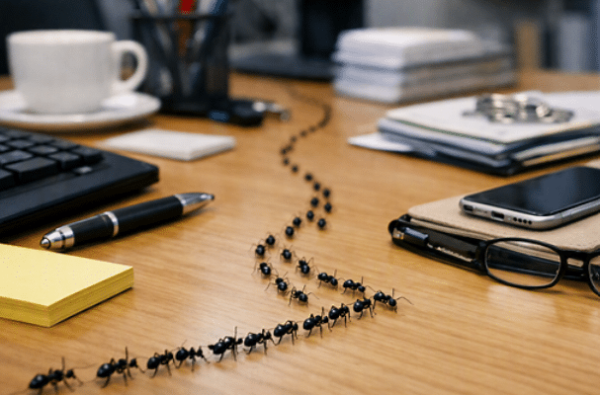
A line of ants crossing a break room counter tends to get treated as an annoyance rather than a genuine concern. Someone wipes the surface, maybe traces the trail back a few feet, and moves on with their day. That reaction makes sense on the surface, but it overlooks what ants were doing before they ever reached that counter. Ants forage across an enormous range of surfaces in a single outing, many of them far less sanitary than an office kitchen, and every trail connecting the two matters more than its size suggests.
What Ants Are Doing Before They Reach the Break Room
Ants don’t originate in office kitchens. They arrive from outside, or from other parts of a building, after foraging across surfaces that have nothing to do with food preparation. A single scout ant might travel through a trash enclosure, cross a floor drain, move along a baseboard in a storage room, and pass over debris in a loading area, all before finding its way through a gap near a break room baseboard.
Each of those surfaces carries its own load of bacteria, and ants pick up microorganisms on their bodies as they travel across contaminated material. Once a scout finds a food source, it lays a pheromone trail that recruits other workers, meaning the ants arriving at a counter or sink are rarely the first to have made that journey. The trail itself represents dozens or hundreds of trips across the same contaminated route, concentrated onto the same narrow strip of surface day after day.
Why This Matters More in Food-Adjacent Spaces
Office break rooms and kitchenettes function differently than a typical desk or conference room, because they involve surfaces where food gets prepared, stored, and consumed. Ants crossing a counter where someone later sets down a sandwich, or walking through a sink where dishes sit before washing, introduce a genuine transfer risk rather than just a visual nuisance.
Research on ants and pathogen transmission has documented that several common household and structural ant species can carry bacteria including E. coli, Salmonella, and Staphylococcus on their bodies after foraging through contaminated environments. This connection between foraging behavior and pathogen transport is part of why sources covering ants contamination disease transmission point specifically to species that move between waste areas and food surfaces as carrying more risk than those confined to purely outdoor foraging. An office break room, sitting adjacent to trash bins, a sink, and food storage all at once, offers exactly the kind of layout where that transfer becomes plausible rather than theoretical.
Trash Areas, Drains, and Storage Rooms as Contamination Sources
Several spaces within a typical office building act as reliable contamination sources for foraging ants, even when they sit some distance from the break room itself. Trash enclosures and waste bins hold food residue and bacterial growth that ants readily exploit, and any colony nesting near a waste area has near-constant exposure to that material. Floor drains in kitchens or janitorial closets accumulate organic buildup inside the trap and along the drain surface, providing another surface ants cross regularly when foraging near plumbing fixtures.
Storage rooms present a less obvious but equally relevant risk. Cardboard boxes, spilled dry goods, and general clutter in a supply closet or storage area can harbor both food residue and the kind of undisturbed conditions ants use for nesting or resting between foraging trips. An ant trail running from a storage room toward a break room has likely crossed several contaminated surfaces along that route, which is part of why the discussion around ants contamination disease transmission treats trail length and origin as relevant details rather than incidental ones. A short trail confined to a clean, dry area carries meaningfully less risk than a longer trail tracing back through a trash enclosure or drain.
Why Repeated Trails Deserve More Than a Wipe-Down
A single ant sighting is rarely cause for alarm. A trail that reappears in the same spot over multiple days, however, indicates an established foraging route, which means the same contaminated path is being crossed repeatedly rather than as an isolated event. Wiping the visible surface removes the ants present at that moment and disrupts the pheromone trail temporarily, but it does nothing to address the route itself or the colony sustaining it.
Facilities staff who treat recurring trails as a cleaning issue rather than a sanitation issue tend to see the same pattern return within days, since the underlying access point and food source remain unaddressed. Persistent activity in the same location, especially near food prep surfaces, sinks, or storage areas, is worth documenting rather than dismissing, since the pattern itself provides useful information about where the colony is nesting and what it’s feeding on.
Improving Food Storage to Remove the Incentive
Reducing available food sources addresses the reason ants are drawn toward a break room in the first place. Sealed, rigid containers for shared snacks, coffee, and any communal pantry items remove the easy access that open bags and boxes provide. Refrigerated items should be checked and discarded on a regular schedule, since forgotten leftovers and spoiled food often become the specific target that establishes a trail in the first place.
Countertops, sinks, and any surface used for food preparation benefit from being wiped down at the end of each day rather than only when visibly dirty, since residue invisible to the eye can still carry enough scent to attract foraging ants. Communal condiment stations, sugar containers, and snack drawers deserve the same scrutiny, as these small, frequently overlooked items are common ant targets in shared office spaces.
Managing Waste to Cut Off a Major Contamination Source
Waste management plays as large a role in ant activity as food storage does, since trash areas are one of the most consistent contamination sources ants encounter. A few adjustments make a meaningful difference:
- Empty trash bins on a fixed schedule rather than waiting until they’re full, since accumulated waste sitting for days gives ants a stable food source to recruit toward
- Use liners in all waste bins and rinse the bins themselves periodically, since residue left on the interior surface continues attracting ants even after the bag is removed
- Keep exterior dumpsters and waste enclosures away from building entrances where possible, reducing the distance ants need to travel between waste and interior spaces
- Clean up spills near trash areas promptly, since spilled liquids or food debris near a waste bin often becomes the first stop on a foraging route that eventually reaches indoor space
Consistent waste management removes one of the most reliable contamination sources available to foraging ants, which in turn reduces both the frequency of trails and the risk associated with whatever trails do appear.
Identifying Entry Points Along a Trail
Tracing a trail back to its entry point provides more useful information than simply eliminating the ants visible at any given moment. Common entry points in office buildings include gaps around utility penetrations, spaces beneath exterior doors, cracks in foundation or flooring near a building’s perimeter, and openings around plumbing fixtures in kitchens or restrooms.
Following a trail during active foraging hours, rather than after it’s already been disrupted by cleaning, makes this tracing far more reliable. Once an entry point is identified, sealing the gap addresses the access route directly rather than relying solely on repeated cleaning to manage the surface-level symptom. This step matters particularly in older office buildings, where gaps around aging utility penetrations or worn door seals often go unnoticed until an ant trail draws attention to them.
Final Analysis
Ant activity in an office break room or food preparation area carries implications beyond appearance, since every trail represents ants that have likely crossed multiple contaminated surfaces before arriving at a spot where food gets stored or prepared. Trash areas, drains, and storage rooms all contribute to that contamination risk, and repeated trails in the same location signal an established route rather than a one-time nuisance. Addressing food storage, waste management, and entry points together gives facilities teams a more complete response than surface cleaning alone, and treating persistent ant activity as a sanitation concern rather than a cosmetic one reflects what the underlying foraging behavior actually involves.