
Let’s say that you hire a developer in Berlin, a designer in São Paulo, and a product manager in Austin. They start Monday; their laptops are stuck in customs or sitting in a former employee’s apartment. Every idle day burns payroll.
The market has noticed. Hardware-as-a-Service climbed from about $120 billion last year to a projected $525 billion by 2031, a 27.8 percent jump fueled by hybrid work and CFOs who prefer OpEx flexibility.
Laptop procurement is now a strategic discipline. You can
1) hand the whole workflow to a device-as-a-service platform
2) buy direct from an OEM or reseller
3) keep patching together one-off Amazon orders and shipping labels.
We benchmarked seven solutions against the metrics that hit your P&L hardest so you can reclaim day-one productivity—without the logistics circus.
How we ranked the field
We didn’t flip a coin or borrow someone else’s list. We asked what IT, HR, and Finance teams complain about most: cost overruns, late deliveries, and laptops that disappear during off boarding. Then we built a scorecard around those pain points.
Seven criteria set the ranking. Cost flexibility carries 25 percent because budgets decide whether a project lives or dies. Delivery speed holds 20 percent; a Firstbase analysis notes that “every laptop delay shows up as wasted payroll and blown budgets.” Global reach and end-to-end lifecycle services earn 15 percent each because remote teams need gear everywhere and retrieval without drama.
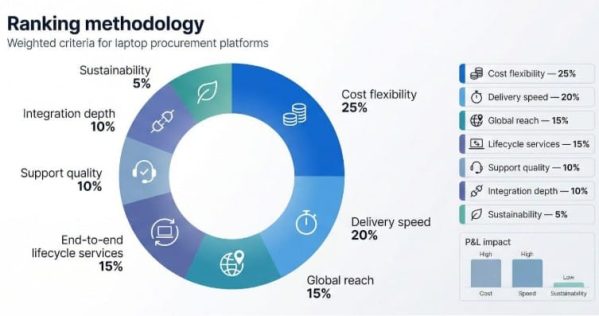
Support quality and integration depth share 10 percent apiece. If a device breaks or your HRIS cannot trigger an order automatically, you are back to firefighting. Sustainability rounds out the list at 5 percent; it matters, but it rarely decides the deal.
We graded two dozen vendors against these weights, mixed public SLA data with real user stories, and surfaced the seven highest scorers. This is not a beauty contest. It is a practical shortlist shaped by the metrics that hit your P&L the hardest.
Up next, we show how each platform stacks up, starting with the one that cuts procurement from a week to a single click.
1. Allwhere: end-to-end device procurement and onboarding
Allwhere turns laptop logistics into a single click. The company’s procurement-and-onboarding page cites a 96 percent on-time delivery rate, evidence that its overnight-shipping guarantee holds up in practice. From choosing a MacBook or Dell to scheduling a doorstep pickup when an employee leaves, every step lives inside one clean dashboard.
The platform now serves about 28 countries, focusing on regions where most remote hires already work. Overnight shipping is standard in North America and Europe, while one-week arrival is typical elsewhere. Because Allwhere owns the process from procurement through certified wipe, your IT team never searches for boxes or customs forms.
Integration is the standout feature. Connect BambooHR or Workday once, and new-hire records trigger automatic orders. Mark someone as terminated, and a prepaid return label lands in the inbox without IT effort. The same workflow can add monitors, chairs, or a branded swag pack to deliver a complete first-day setup.
Costs remain in OpEx territory. You pay per device or per user, skip minimum-seat commitments, and view real-time dashboards that flag reuse opportunities when a laptop returns in good condition.
If you want procurement to feel as easy as spinning up a cloud server, start your shortlist here. A short demo on Allwhere’s site walks through the entire journey in under ten minutes.
2. Dell Premier and APEX PC-as-a-Service: direct from the source
Sometimes the simplest answer is to buy straight from the manufacturer. Dell’s enterprise portal, Premier, offers bulk pricing, custom imaging, and a rep who can quote five laptop SKUs in minutes. If you want to avoid capital expense, APEX PC-as-a-Service spreads the bill over three predictable years and includes ProSupport next-business-day repairs.
Coverage is Dell’s ace. The company ships to more than 170 countries and can service hardware almost anywhere employees work. That global muscle keeps sticker prices low and availability high, especially when you standardize on a few models.
The trade-off is lifecycle effort. Dell will not chase a laptop hiding in a former intern’s closet or create a return label when HR off-boards someone. Your team must handle retrieval, storage, and redeployment, or add another vendor to cover that gap.
Choose Dell when the cost per unit and factory-level support outweigh the cost of white-glove logistics. It remains a scale-friendly option, provided you have the internal bandwidth to finish the last mile.
3. CDW and global resellers: the familiar, flexible option
If Dell is the factory, CDW is the megastore. Thousands of companies already place purchase orders through CDW because the process feels familiar: pick a model, negotiate a bulk discount, and have it on a truck tomorrow.
Speed is the headline. For in-stock laptops, next-day delivery across North America is routine, and European subsidiaries see similar turnaround thanks to CDW’s acquisition streak. Configuration centers can pre-image devices, add asset tags, and drop-ship straight to employees, saving another day of onboarding.
The model creaks after day one. Returns, refresh cycles, or chasing equipment across borders stay on your plate unless you add separate recycling or courier contracts. CDW will help, for a fee, but there is no always-on lifecycle engine running in the background.
Choose a reseller path when you need low hardware pricing, already track assets internally, and want the freedom to mix Dell, Lenovo, Apple, or whatever spec a power user requests. Think of it as a multi-tool for procurement: versatile and reliable, yet it still requires your hand on the handle.
4. Amazon Business: fast, hands-off-the-wheel DIY
Need a laptop tomorrow and do not care about extras? Open Amazon Business, click “MacBook Air,” choose overnight shipping, and check out before the coffee cools.
That speed is Amazon’s core appeal. In major markets, same-day or next-day delivery cuts onboarding delays to near zero. Pricing stays competitive for single units; bulk discounts start at 5 or 10 devices, and Business Prime offers 45-day payment terms, useful when cash flow is tight.
Everything beyond the brown box is manual. You handle imaging or MDM enrollment, coordinate returns, and trust that former employees send gear back. For cross-border hires, Amazon’s regional walls force separate accounts and added tax steps.
Treat Amazon as an emergency valve or for very small teams that prize speed over structure. As laptop counts climb or locations multiply, the hidden effort grows and the cost advantage narrows.
5. Firstbase: subscription simplicity, with strings attached
Firstbase earned its reputation by promising to ship and retrieve laptops, peripherals, and accessories worldwide with almost no IT effort. Add a new hire in the portal, and an approved device ships, lands, and auto-enrolls in your MDM with minimal touch.
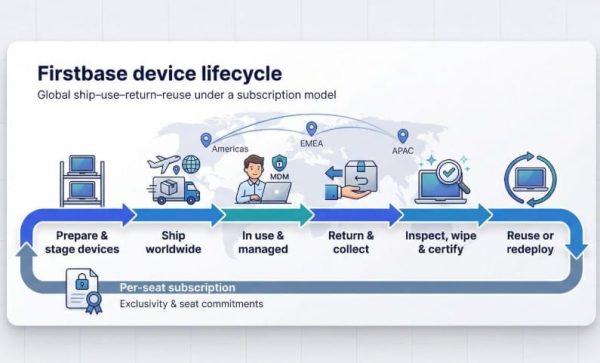
Coverage spans more than 90 countries, and the company keeps spare devices on hand so replacements leave the shelf within hours. Returned equipment is inspected, wiped, and flagged for reuse, cutting replacement costs and supporting sustainability goals.
The catch sits in the contract. Firstbase often asks for exclusivity and a multi-seat commitment. Monthly per-seat pricing bundles hardware, storage, and logistics into a single figure, yet it can outprice pay-as-you-go options if hiring slows.
Choose Firstbase when you want a mature, end-to-end engine and are comfortable locking the entire fleet into a single lane. For ultimate flexibility, the next vendors avoid those strings.
6. GroWrk: global coverage without contract handcuffs
GroWrk keeps the offer straightforward: ship laptops to staff in more than 150 countries and pay only when a device moves. There are no seat minimums, no exclusivity clauses, just a freemium dashboard that scales on demand.

Regional warehouses make the difference. Order a ThinkPad for a new hire in Lagos, and it ships from within Africa rather than crossing an ocean. Typical delivery arrives in under a week, and the platform posts transparent SLAs so you know the deadline before clicking “confirm.”
GroWrk integrates with JumpCloud so devices join your MDM the moment the courier scans the label. HRIS hooks are lighter than Allwhere’s, but the pay-per-use model appeals to companies that surge hiring one quarter and pause the next.
Costs stay predictable: hardware price plus a clear logistics fee. You can store returned devices in GroWrk’s warehouse or recycle them; either way, invoices remain à la carte rather than bundled subscriptions.
Choose GroWrk when geographic sprawl makes other vendors pause and financial flexibility matters more than an all-in contract. It provides a worldwide safety net without locking you in.
7. Deel IT (formerly Hofy): HR and hardware under one roof
Deel turned global payroll into a simple electronic signature. When it acquired Hofy in 2024, laptops joined the same workflow, so a single “create employee” action now generates a work contract, tax forms, and a MacBook for the hire’s desk (TechCrunch, July 2024).
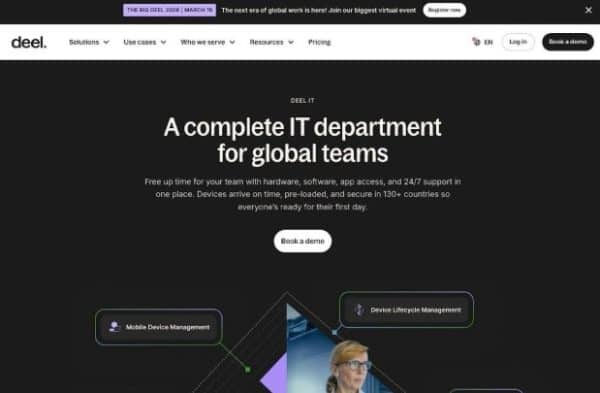
That HR-first approach streamlines the experience. Set a device allowance, select preferred models, and step back. On the start date, tracking emails go out automatically. When an employee leaves, Deel schedules a courier pickup and remotely locks the machine before HR closes the ticket.
Coverage runs on Deel’s Employer-of-Record network, currently about 100 countries and growing. Delivery targets one to two weeks, helped by Hofy’s European warehouses.
Cost appears as an add-on line in the same invoice you already receive for payroll and benefits. If you are already a Deel customer, that bundling feels efficient. For everyone else, adding an entire HR stack just for devices is a big leap.
Choose Deel IT when your onboarding already flows through Deel and you want a single provider for contracts and computers. If you operate outside that ecosystem, the convenience premium may outweigh the benefit, and a standalone device platform could fit better.
Conclusion
We just walked through seven very different routes to outfitting your team. To help you pick a front-runner, we distilled the key numbers into a single, easy-scan matrix. The table lists delivery speed, country coverage, pricing model, and one standout feature for each vendor.
Treat it like a checklist. Need overnight shipping to Toronto and Lisbon? Allwhere shows green in the Speed column, while Dell stays amber unless you choose standard stock. Worried about contract lock-in? GroWrk and Amazon stay bright green for flexibility, whereas Firstbase turns red because of exclusivity terms.
The table is not a scoreboard. It is a filter. Circle the metrics that move your P&L—maybe OpEx versus CapEx or pure geographic reach—then cross out any platform that falls short. In two minutes, you can narrow seven options to two, ready for demos.