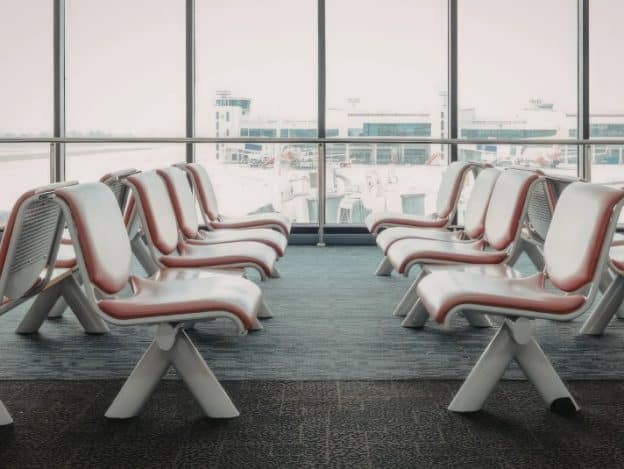
Picture this: you have just sprinted half a mile through a crowded terminal, your carry-on is cutting into your shoulder, and your gate has been pushed back ninety minutes. You drop into the nearest chair, and it actually feels good. Sturdy, well-proportioned, the right height. You relax for the first time in three hours.
That experience does not happen by accident. Someone made a deliberate procurement decision that put the right chair in that spot, and for airport administrators and facility managers, that decision carries real weight. Seating that fails in a public terminal fails loudly, with broken frames, torn upholstery, accessibility complaints, passenger frustration. Seating that works just disappears into the background, which is exactly what good infrastructure should do.
This guide covers five commercial retailers worth evaluating for airport seating projects in 2026. These are not general furniture companies that happen to sell chairs. Each one has a specific angle, volume, design, track record, accessibility, or custom fabrication that makes them relevant to the people actually responsible for outfitting high-traffic terminals.
1. InStockChairs: Built for Volume, Ready to Ship
Most commercial furniture vendors manufacture to order. That works fine when your timeline is flexible. For airport procurement teams dealing with hard opening dates, phased rollouts, or emergency replacements, a three-month lead time is a genuine problem.
This airport seating retailer solves that. The company keeps a substantial ready inventory of commercial and institutional seating, so you can place a large order and expect delivery on a timeline that actually fits your project. Their catalog is purpose-built for high-traffic environments, such as airports, transit hubs, hospitals, and convention centers, which means you are not sorting through residential product lines hoping something is durable enough. Bulk pricing is structured for large-scale procurement, and their ordering process is calibrated for institutional buyers rather than one-off consumers.
For facilities teams that know what they need and cannot afford delays, InStockChairs removes most of the friction. Their focus on commercial clients means the people you work with understand the difference between a chair that photographs well in a showroom and one that still looks respectable after 50,000 passengers have used it.
2. Modernofficefurniture: Aesthetics That Hold Up Under Pressure
Plenty of airports have moved past the era of bolted plastic rows and fluorescent lighting. Terminal renovations today are increasingly design-conscious, and seating is a meaningful part of that visual identity. modernofficefurniture sits at the intersection of contemporary design and legitimate commercial durability, which is a harder combination to find than it sounds.
Their catalog spans lounge chairs, benches, modular systems, and task seating, sourced from manufacturers with real commercial credentials. The product line skews toward a refined, current look that works well in premium gate areas, executive lounges, and spaces where the airport is investing in a higher level of passenger experience. Trade and contract pricing is available, and their detailed spec sheets simplify the specification process for procurement teams and designers alike.
If your project involves an interior design firm or a brand-conscious operator, modernofficefurniture is worth getting into the conversation early. They treat a chair in a premium terminal as doing aesthetic work alongside functional work, and they are right.
3. National Business Furniture: Experience That Counts
Founded in 1975, National Business Furniture has been supplying offices, government facilities, healthcare environments, and transit spaces long enough that their institutional knowledge is genuinely valuable. There is a quiet reliability that comes with a vendor who has solved procurement problems across hundreds of large-scale projects over five decades.
Their airport-relevant product range covers lobby and reception seating, tandem and beam systems, stack chairs suited for multi-use spaces, and ergonomic options designed to accommodate a wide range of body types. That last point matters more in public environments than people give it credit for; a terminal serves everyone, and seating that only works well for an average build is not really doing its job.
Customer support is where they consistently earn marks. Their team understands phased timelines, large institutional orders, and the coordination complexity that comes with outfitting an active terminal. For projects with complicated scopes, that experience can prevent problems a less seasoned vendor would not even see coming.
4. Sitmatic: Ergonomics and Accessibility Done Right
Public infrastructure has a responsibility that private office furniture does not. Airports serve everyone: passengers with mobility challenges, larger body types, older travelers, people recovering from injury. Seating that meets the minimum ADA threshold without genuinely thinking about diverse physical needs is doing the bare minimum.
Sitmatic has built their commercial reputation around ergonomic and accessible seating. Their lineup includes bariatric options rated for higher weight capacities, reinforced frames, and designs that support proper posture over extended sitting periods, the kind of detail that matters when a passenger is parked in a chair for four hours during a delay. Customization is available across fabric and finish options, so their products do not have to look clinical or institutional. For terminals upgrading to meet modern accessibility expectations without sacrificing appearance, Sitmatic is a thoughtful choice.
5. Spec Furniture: When the Project Calls for Something Custom
Some airport projects go beyond standard procurement. Custom dimensions for unusual concourse configurations, proprietary upholstery to match a terminal’s brand palette, integrated charging built into the seat frame, beam systems engineered for a specific layout. These are contract-level requirements, and that is exactly where Spec Furniture operates.
They work primarily with designers, architects, and procurement teams on large commercial installations, meaning their process is already calibrated for the specification detail that major infrastructure projects demand. Their catalog includes beam seating, modular lounge collections, and configurable systems that adapt to almost any terminal footprint. If your project involves an architecture or design firm, Spec Furniture integrates naturally into that workflow. They treat seating as part of a broader operational and design vision rather than a furniture line item.
What Actually Matters When Buying Airport Seating in 2026
Durability and Warranty Terms
Steel or reinforced aluminum frames, high-cycle upholstery, and warranty coverage spanning at least five to ten years should be baseline expectations. A cheaper option that needs replacing in two years will cost more over time, and the operational disruption of mid-cycle replacement adds hidden cost that rarely shows up in the initial comparison.
ADA Compliance and Accessibility
Current ADA requirements should be the floor, not the ceiling. Adding bariatric options and open zones for wheelchair users reflects genuine accessibility thinking rather than minimum compliance.
Integrated Charging
USB-A, USB-C, and wireless charging have moved from amenity to expectation in major terminals. Passengers assume they can charge a device at their gate. Seating that accommodates this upfront is easier and cheaper than retrofitting later.
Lead Times
Supply chains have largely stabilized, but lead times still vary significantly between vendors. If your project has a fixed opening date, confirm actual production and delivery schedules before committing. A great chair that arrives six weeks after your terminal opens solves nothing.
Cleanability
Airport cleaning crews work around the clock with commercial disinfectants and zero tolerance for deterioration. Antimicrobial fabric treatments, stain-resistant finishes, and surfaces that hold up to industrial cleaning chemicals are worth specifying wherever possible.
Frequently Asked Questions
What does commercial airport seating cost per unit?
Basic tandem beam seating typically runs $150 to $300 per seat. Premium lounge seating with integrated charging and custom upholstery can reach $800 to $2,000 or higher. Bulk orders reduce per-unit costs meaningfully.
What weight capacity should airport chairs meet?
Standard commercial seating is generally rated for 400 to 500 pounds. Bariatric designations call for 600 to 1,000 pounds, with reinforced frames and wider seat pans.
Can seating be customized with terminal or airline branding?
Yes. Most commercial retailers offer proprietary fabric colors, embroidered logos, custom powder-coat finishes, and bespoke configurations. Contract-focused suppliers like Spec Furniture specialize in this and are set up to handle it efficiently at scale.
Final Thoughts
Passengers rarely notice seating when it is done well. They absolutely notice when it is not. A cracked frame, a collapsing armrest, a chair that is impossible to exit with a roller bag at your feet, these details accumulate into an impression of the entire facility.
The five retailers here each bring something distinct. InStockChairs for volume and speed. ModernFurniture for design-forward procurement. National Business Furniture for institutional depth. Sitmatic for accessibility and ergonomic rigor. Spec Furniture when the project requires something built from scratch.
Get samples before you commit, review warranty terms carefully, and talk to facilities managers who have actually purchased from these suppliers. The decisions made in procurement meetings today are what passengers experience for the next decade. The same logic applies to any commercial environment, and OfficeFinder’s guide to building productive workspaces is worth a read if you are thinking beyond seating alone.